Physiological sigh
The physiological sigh is two inhales followed by one long exhale: breathe in through your nose, then — without breathing out — take a second, shorter inhale right on top of it, then breathe out slowly through your mouth. One cycle takes ten seconds, and the timer on this page counts each phase for you, with a tone at every change.
Before you start
Stop if dizzy. Never in water or while driving. Pregnant or have a health condition? Ask a doctor.
- If you are pregnant, or live with a long-term health condition, talk to a doctor before you start.
- Never practice while driving, cycling, or in or near water.
- Stop and breathe normally if you feel dizzy or lightheaded, or have pain or pressure in your chest.
Done
Sound & length
Tap Share, then Add to Home Screen.
Open your browser menu, then choose Install app or Add to Home screen.
| # | Phase | Seconds |
|---|---|---|
| 1 | Inhale | 3 |
| 2 | Inhale again | 1 |
| 3 | Exhale | 6 |
How to do it
- Sit upright somewhere you won’t need to move for a minute or two.
- Breathe out fully before you start, so the first inhale begins from empty.
- Tap the speaker in the corner of the timer to turn the sound on — it’s off until you choose it.
- Press start. The timer counts down from three.
- Breathe in through your nose while the dot travels the first, longer arc.
- Without breathing out, take a second, shorter inhale through your nose right on top of the first, on the short arc that follows.
- Breathe out slowly through your mouth for the long final arc, all the way to empty.
- That’s one cycle. The timer repeats it — three times by default — and then stops.
This pattern is usually done for one to three cycles at a time, not a long session — unlike the other techniques here, which run for a minute or more. Session length is still yours to set: the timer’s settings let you choose how many cycles or how much time to run.
Where the pattern comes from
A sigh in this exact shape happens on its own — during sleep, after crying, at the tail end of a yawn. This technique reproduces it on purpose, on a count, instead of waiting for it to happen. Repeated for several minutes, as in the study below, it is called cyclic sighing. It is a counting pattern, not a treatment.
Why there are two inhales
The second inhale doesn’t start over — it tops up the air already in your lungs on top of the first breath, with the chest never resetting in between. On the timer screen, this shows as two halves of the breathing disc’s rise: it fills halfway on the first inhale (three seconds), then the rest of the way on the second, short inhale (one second). The arc for that second phase is short on the circle simply because the phase itself is short — one second out of a ten-second cycle, not because it counts for less.
Research
Studies that examined this pattern. Each one describes what was measured in the people who took part, not what the pattern will do for you.
A one-month remote study in which one group practiced cyclic sighing — this pattern, repeated for five minutes a day — alongside groups doing box breathing, cyclic hyperventilation and mindfulness meditation.
Balban et al. (2023). Brief structured respiration practices enhance mood and reduce physiological arousal. Cell Reports Medicine. doi:10.1016/j.xcrm.2022.100895
Questions
- How long is one cycle of the physiological sigh?
- One cycle takes 10 seconds: inhale for 3, inhale again for 1, exhale for 6. The timer marks each change with a tone.
- How long is a session on this timer?
- The timer opens with 3 cycles, 30 seconds. You can set a different number of cycles, or a length in minutes, in the timer settings before you start.
- Who should not do the physiological sigh?
- If you are pregnant, or live with a long-term health condition, talk to a doctor before you start. Never practice while driving, cycling, or in or near water. Stop and breathe normally if you feel dizzy or lightheaded, or have pain or pressure in your chest. This is not medical advice.
- Does the physiological sigh timer work offline?
- Yes. After your first visit the page keeps working without a connection, and you can install it to your home screen like an app. There is no sign-up and no app store.
Physiological sigh GIF
Download this physiological sigh GIF for slides, Notion, email or a classroom screen, in a light or a dark version. It loops one 10-second cycle. For sound cues and a session timer, use the timer above.


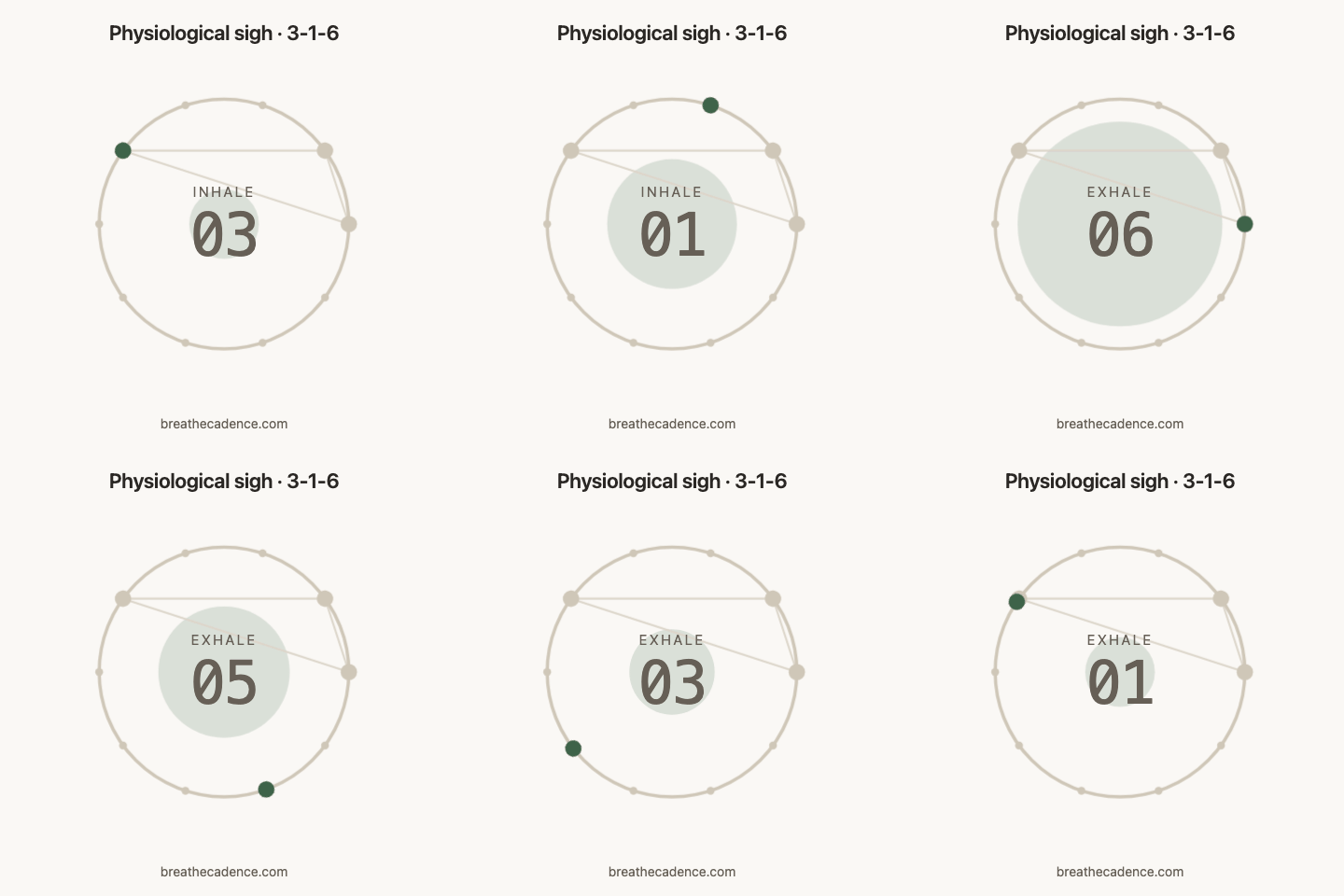
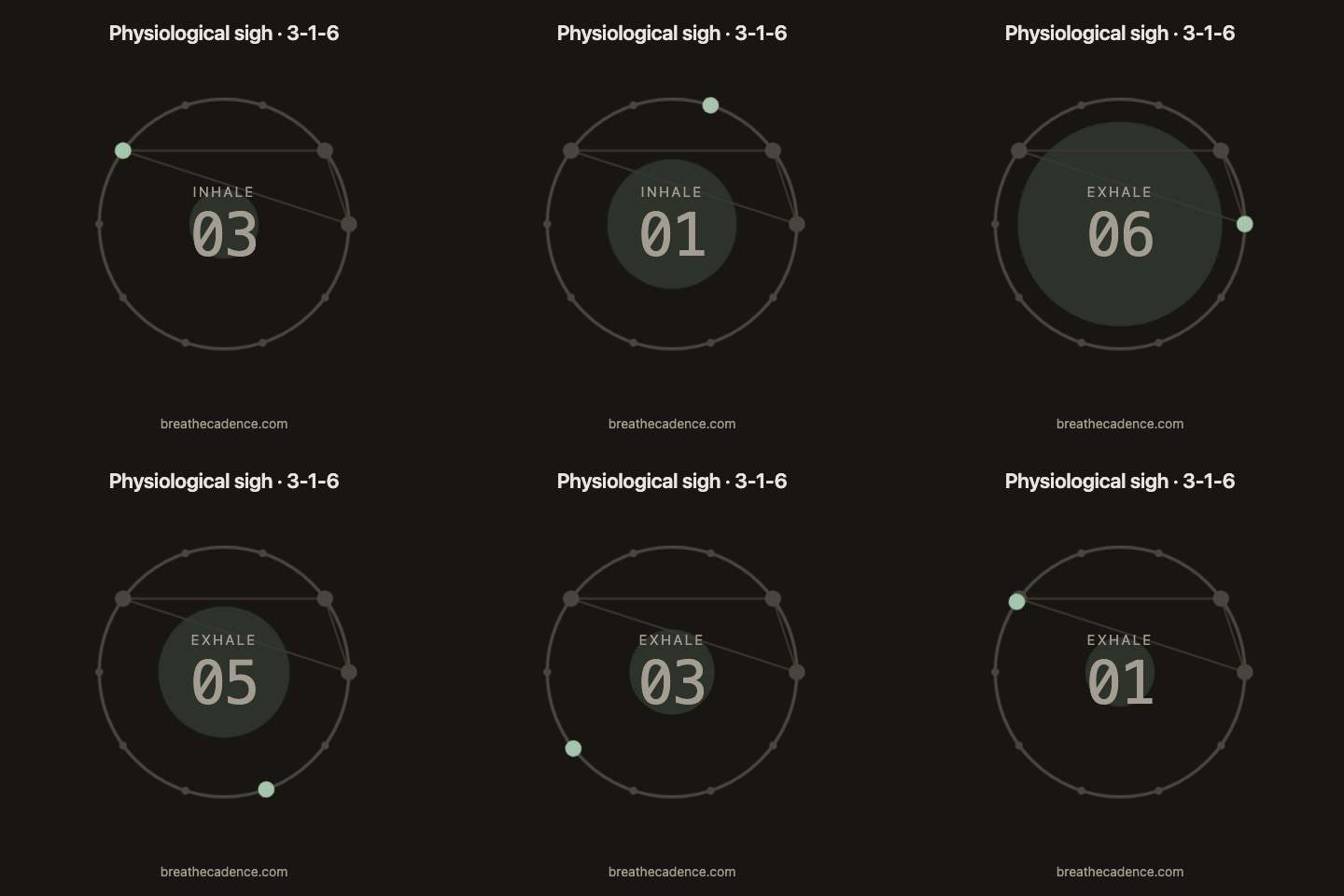
Free to reuse under the CC BY 4.0 license with credit to Breathe Cadence. License details
Other techniques
Same timer, different pattern. Each one opens with its own rhythm and its own default session length.
Box breathing
Four equal phases: in, hold, out, hold.
4-4-4-4 seconds
4-7-8 breathing
A short inhale, a long hold, a longer exhale.
4-7-8 seconds
Coherent breathing
Even in and out, no holds, six breaths a minute.
5-5 seconds
Diaphragmatic breathing
Slow belly breaths, the exhale longer than the inhale.
4-6 seconds
4-6-8 breathing
Like 4-7-8, with the hold a second shorter.
4-6-8 seconds
Set your own pace
The same timer with the numbers left to you: pick a preset, or step each phase up and down.
Published , updated . Written by the Breathe Cadence team, from personal practice rather than clinical training.