Diaphragmatic breathing
Diaphragmatic breathing, also called belly breathing or abdominal breathing, means breathing low into your belly so the diaphragm does the work, not your chest and shoulders. It has no fixed count: the timer on this page paces it at four seconds in and six out, with no holds and a tone at every change, so you can close your eyes and just follow the sound.
Before you start
Stop if dizzy. Never in water or while driving. Pregnant or have a health condition? Ask a doctor.
- If you are pregnant, or live with a heart, lung or blood-pressure condition, talk to a doctor before you start.
- Never practice while driving, cycling, or in or near water.
- Stop and breathe normally if you feel dizzy, lightheaded or short of breath, or have pain or pressure in your chest.
Done
Sound & length
Tap Share, then Add to Home Screen.
Open your browser menu, then choose Install app or Add to Home screen.
| # | Phase | Seconds |
|---|---|---|
| 1 | Inhale | 4 |
| 2 | Exhale | 6 |
Want other numbers? Open this pattern in the custom breathing timer.
How to do it
- Sit or lie down somewhere you won’t need to move for a few minutes. Put one hand on your belly and one on your chest.
- Tap the speaker in the corner of the timer to turn the sound on — it’s off until you choose it.
- Press start. The timer counts down from three.
- Breathe in through your nose while the dot travels the first arc. The hand on your belly should rise; the hand on your chest should stay almost still.
- Breathe out, through pursed lips or through your nose, whichever is easier, as the dot travels the second arc, and feel your belly fall back under your hand.
- Let the next inhale begin the moment the exhale ends — there is no hold in this pattern.
A few minutes is a normal first session. Choose a session length you can finish without straining, and keep coming back to the hand on your belly rather than the count.
Where the pattern comes from
Belly breathing and abdominal breathing are other names for the same practice. Unlike box breathing or 4-7-8, it has no single fixed count. The timer above runs 4 seconds in and 6 out because the practice is usually taught with a longer exhale than inhale. If that pace feels too slow or too fast, set your own in paced breathing, keeping the exhale longer than the inhale. For an even pace, coherent breathing runs five seconds in and five out. It is a breathing practice, not a treatment.
Belly, not chest
The thing to track is the hand on your belly, not the count and not the hand on your chest. On the inhale, that lower hand should push out first and most; the upper hand on your chest stays quiet. If you notice your chest rising and your shoulders lifting instead, breathe more gently: take in less air, let the movement drop back to your belly, and bring your attention back to the lower hand until it is doing the moving again.
Research
Studies that examined this pattern. Each one describes what was measured in the people who took part, not what the pattern will do for you.
An eight-week study in healthy adults that compared a group trained in diaphragmatic breathing with a control group, measuring sustained attention, self-reported affect and cortisol.
Ma et al. (2017). The Effect of Diaphragmatic Breathing on Attention, Negative Affect and Stress in Healthy Adults. Frontiers in Psychology. doi:10.3389/fpsyg.2017.00874
Questions
- How long is one cycle of diaphragmatic breathing?
- One cycle takes 10 seconds: inhale for 4, exhale for 6. The timer marks each change with a tone.
- How long is a session on this timer?
- The timer opens with a 3-minute session, which is 18 cycles. You can set a different number of cycles, or a length in minutes, in the timer settings before you start.
- Who should not do diaphragmatic breathing?
- If you are pregnant, or live with a heart, lung or blood-pressure condition, talk to a doctor before you start. Never practice while driving, cycling, or in or near water. Stop and breathe normally if you feel dizzy, lightheaded or short of breath, or have pain or pressure in your chest. This is not medical advice.
- Does the diaphragmatic breathing timer work offline?
- Yes. After your first visit the page keeps working without a connection, and you can install it to your home screen like an app. There is no sign-up and no app store.
Diaphragmatic breathing GIF
Download this diaphragmatic breathing GIF for slides, Notion, email or a classroom screen, in a light or a dark version. It loops one 10-second cycle. For sound cues and a session timer, use the timer above.


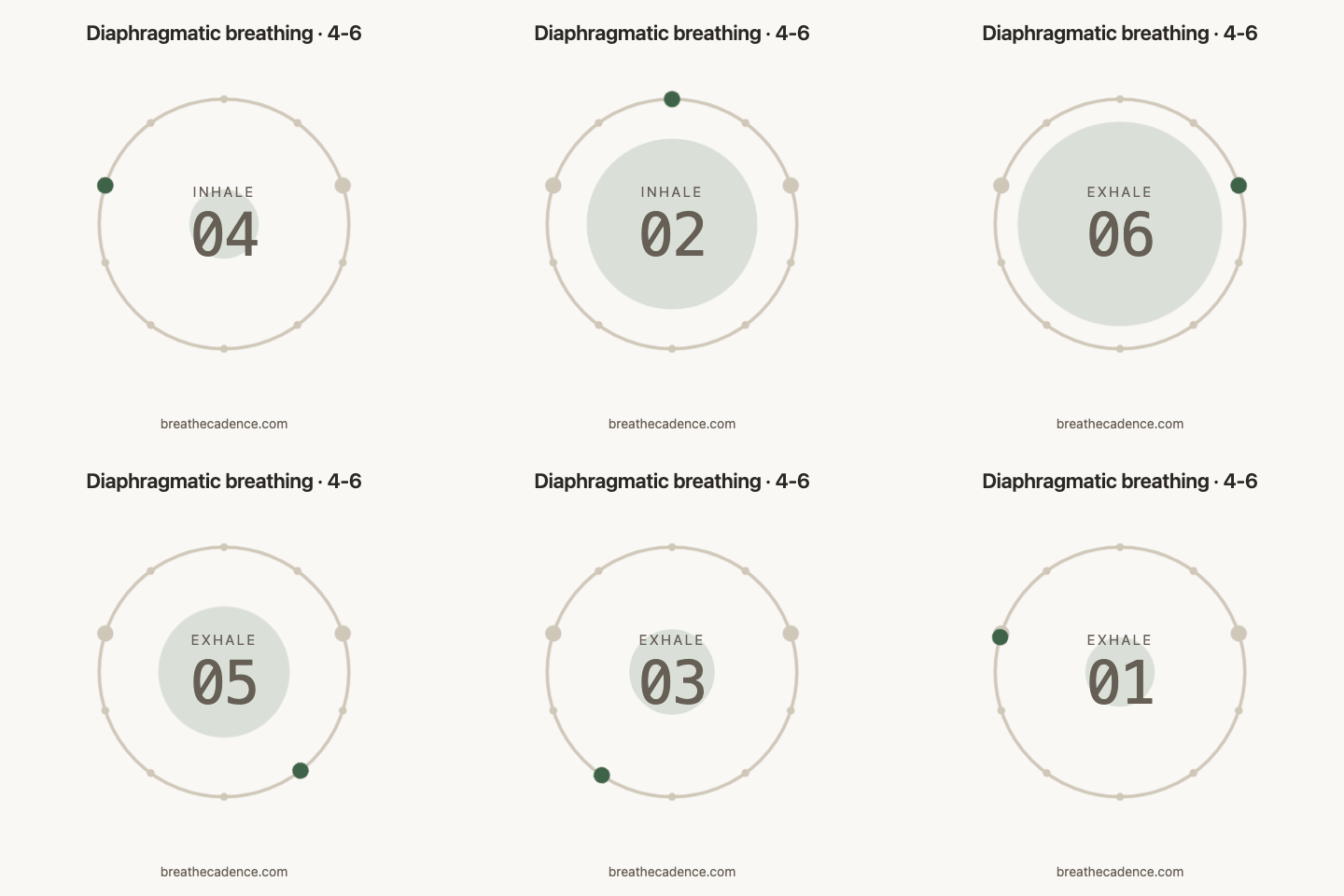
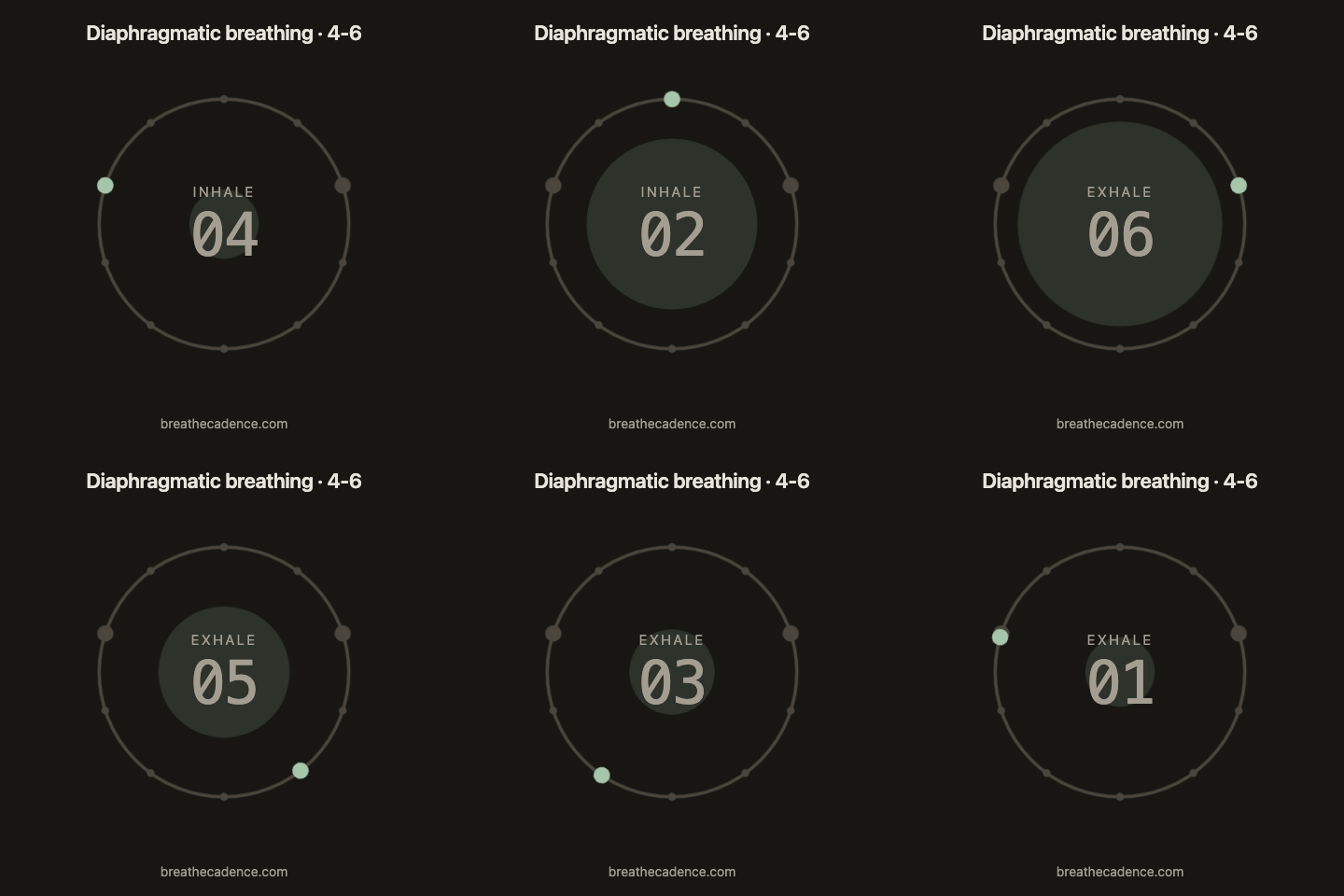
Free to reuse under the CC BY 4.0 license with credit to Breathe Cadence. License details
Other techniques
Same timer, different pattern. Each one opens with its own rhythm and its own default session length.
Box breathing
Four equal phases: in, hold, out, hold.
4-4-4-4 seconds
4-7-8 breathing
A short inhale, a long hold, a longer exhale.
4-7-8 seconds
Coherent breathing
Even in and out, no holds, six breaths a minute.
5-5 seconds
Physiological sigh
Two inhales back to back, then one long exhale.
3-1-6 seconds
4-6-8 breathing
Like 4-7-8, with the hold a second shorter.
4-6-8 seconds
Set your own pace
The same timer with the numbers left to you: pick a preset, or step each phase up and down.
Published , updated . Written by the Breathe Cadence team, from personal practice rather than clinical training.